Agriculture in Africa sits at a paradox.
The continent holds nearly 65% of the world’s uncultivated arable land and employs about 60% of its workforce. Yet productivity remains low. Many farms operate at less than half of their potential, post-harvest losses range between 30–40% in countries like Nigeria, and access to finance is still severely limited.
At the center of this paradox is a constraint that is often overlooked: the absence of reliable, accessible, and actionable data at the farm level.
For decades, interventions have focused on inputs—fertilizers, improved seeds, mechanization. While important, they have not solved the core issue.
The real gap is not just inputs.
It is visibility.
Agriculture across much of Africa still operates in an information vacuum—where decisions are based on intuition, risks are difficult to quantify, and coordination across the value chain is weak.
This article argues a simple but critical point: Data must be treated as core agricultural infrastructure and this perspective is informed not just by research but by direct experience building and operating agricultural systems.
The Problem: Agriculture Without Visibility
Agricultural systems across Africa are fragmented and opaque. Smallholder farmers—who make up the majority—often lack access to:
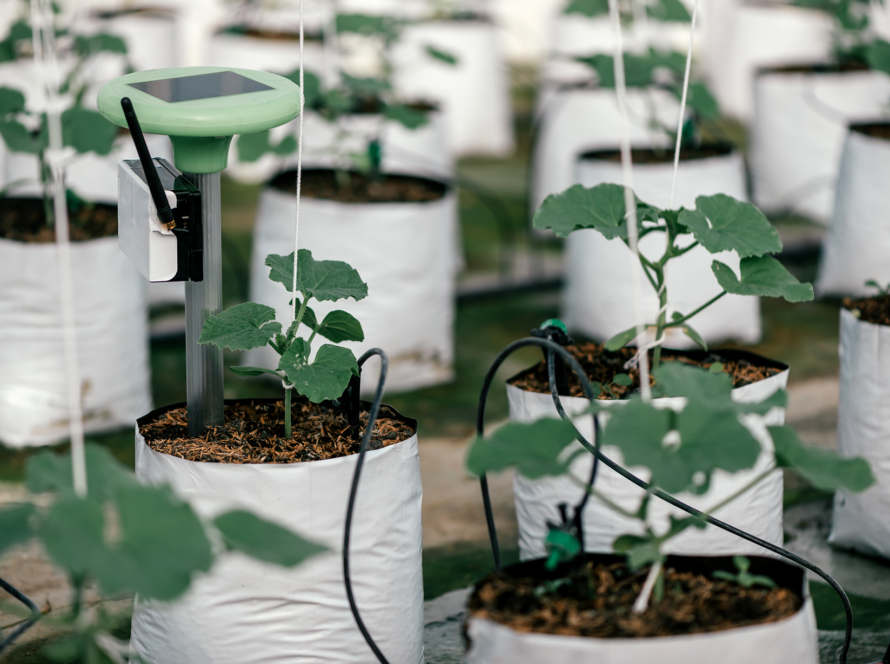
- Real-time soil and environmental data
- Localized weather intelligence
- Structured records of farm performance
- Reliable market signals on demand and pricing
This lack of visibility creates a chain reaction of inefficiencies.
1. Poor decision-making at the farm level – Without accurate data on soil moisture, temperature, and nutrient conditions, farmers cannot optimize irrigation, input usage, or planting cycles. The result is waste, inefficiency, and persistent yield gaps.
2. Limited access to finance – Financial institutions struggle to lend because risk cannot be properly assessed. Without data, agriculture appears unpredictable and high-risk.
3. Weak value chain coordination – Processors, buyers, and logistics providers operate with limited insight into production volumes and timing, leading to missed opportunities and inefficiencies.
In simple terms: Agriculture is not just under-resourced—it is under-informed.
Why Data Matters: From Reactive to Predictive Agriculture
Data transforms agriculture from a reactive activity into a predictive system.
With reliable data, farmers can:
- Anticipate weather risks
- Optimize water and input usage
- Detect crop stress early
- Make better harvesting and storage decisions
Beyond the farm, the impact multiplies.
Data enables:
- Better lending decisions through improved risk assessment
- Smarter insurance products, including parametric insurance
- Efficient supply chains with real-time production visibility
- Stronger policy decisions driven by evidence rather than assumptions
Data is not just an operational tool.
It is a system-wide enabler.
Data as Infrastructure, Not a Tool
A fundamental shift is needed.
Today, data is often treated as a feature—an add-on to existing systems. But in reality, data should be viewed as infrastructure, similar to roads, irrigation systems, or storage facilities.
Just as physical infrastructure enables the movement of goods, data infrastructure enables the movement of information. And that information is critical for:
- Decision-making
- Risk management
- Market coordination
- Investment readiness
Without this layer, other interventions lose effectiveness.
Fertilizer can increase yields—but without data, application is inefficient.
Finance can expand access—but without data, risk remains high.
Data sits at the intersection of all these systems.
The Investment Case: Making Agriculture Investable
One of the biggest barriers to agricultural investment in Africa is uncertainty.
Investors need:
- Predictability
- Traceability
- Measurable performance
Agricultural data systems provide all three. They enable:
- Reduced perceived risk – Better data allows lenders and investors to make informed decisions.
- New financial products – Data supports credit scoring, insurance models, and structured financing.
- Supply chain transparency – Buyers can make confident procurement decisions.
- Aggregation and scale – Fragmented farms can be understood and managed collectively.
Over time, this shifts agriculture from a high-risk sector to a structured, investable asset class.
Climate Resilience and Sustainability
Climate variability is already reshaping agriculture across Africa.
Erratic rainfall, rising temperatures, and soil degradation are no longer future risks—they are current realities. Data plays a critical role in building resilience by:
- Detecting environmental stress early
- Supporting adaptive decision-making
- Optimizing water use
- Enabling sustainable land management
In this context, data is not just about productivity.
It is about adaptation and survival.
Challenges to Building Data Infrastructure
Despite its potential, building agricultural data systems is not straightforward. Key challenges include:
- High deployment costs in rural areas
- Fragmented data across stakeholders
- Limited digital literacy
Concerns around data ownership and trust
Addressing these requires:
- Public-private collaboration
- Context-driven design
- Clear data governance frameworks
- Farmer education and capacity building
Africa’s agricultural challenge is not just about land, labor, or capital. It is about visibility.
Treating data as infrastructure provides a pathway to:
- Increase productivity
- Strengthen climate resilience
- Unlock investment
The future of agriculture will not be defined solely by those who produce more, but by those who understand more. And in that future, data is not an accessory—it is the foundation.